
3D printed fidget balls, explained: printed in one piece, fold forever
What a fidget ball is, how the hinges get printed already moving, fidget ball vs infinity cube vs clicker, and how to pick one that lasts.
in this guide
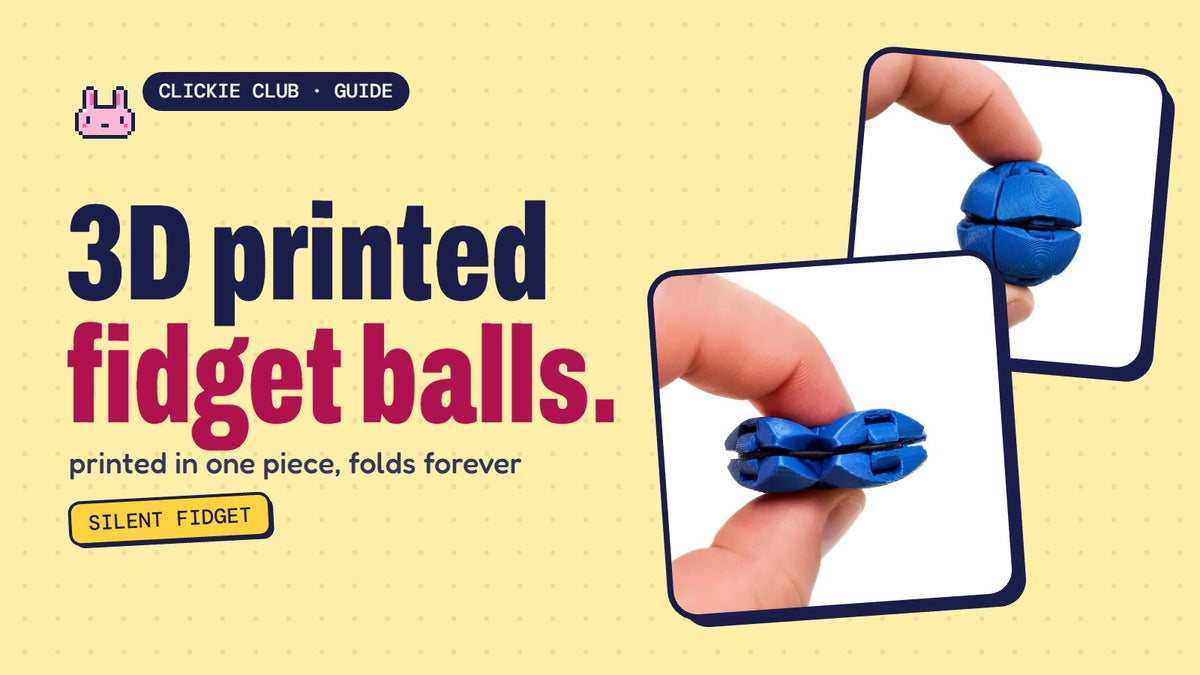
A 3D printed fidget ball is the trick that makes people go "wait, how?" It's a sphere made of linked segments that folds inside out, over and over, forever. No hinges to assemble, no pins, no glue: it comes off the printer already moving. We print and sell our own version, called Zorbles, so this is the guide we wish existed when we started: how they work, how they're printed in one piece, what can go wrong, and how to pick a good one.
the short version: fidget balls are printed as one object with tiny gaps between the segments, so the hinges exist the moment the print finishes. They're quiet, pocket-sized, and the best fidget for people who can't stand clicking. Buy one with clean layer lines, smooth folding out of the box, and a maker who designed it. Zorbles start here →
what is a fidget ball?
Picture a ball cut into a ring of linked lobes. Push the top in, the sides fold over, and the ball turns itself inside out into… the same ball. Then you do it again. It's the same satisfying loop as an infinity cube, but round, softer in the hand, and silent. People use them for focus, for anxiety in meetings, and for the simple reason that the motion is hypnotic.
Other names you'll see: flip ball, infinity ball, fold ball, "that ball that folds into itself." They're all the same idea.
how a fidget ball is 3D printed in one piece
This is the part people don't believe. The whole ball, every hinge included, is printed in a single job:
- the design leaves gaps. Each segment is modeled with a clearance of roughly 0.3 mm around its neighbor. The printer prints both sides of that gap, and the gap stays a gap.
- the hinges are "print-in-place." The hinge pin and the hinge hole are printed around each other, layer by layer, never touching. When the print cools, you snap them free with the first fold.
- no supports inside. A well-designed fidget ball is shaped so every overhang is printable without scaffolding, which is why the inside stays clean and smooth.
- the first fold is the hardest. Fresh off the printer, a tiny film of plastic may bridge the gaps. The first few folds break it, and the ball loosens into its final, buttery feel.
Ours print in about an hour on a Bambu P2S at 0.2 mm layers, in PLA for a crisp feel or PETG when it's going to be thrown in a bag. 12 colors, including glow-in-the-dark.
fidget ball vs. infinity cube vs. clicker
| fidget ball | infinity cube | clicker | |
|---|---|---|---|
| noise | Silent | Soft clack | Loud click |
| motion | Fold / roll | Fold / flip | Press |
| best for | Classrooms, libraries, quiet focus | Desk fidgeting | People who need the sound |
| pocketable | Yes | Mostly | Yes |
| ours | Zorbles | Coming | Gentleman Frog, Multi Fidget |
what makes a good 3D printed fidget ball
- It folds smoothly out of the box. Stiff is fine for the first 10 folds. Stuck is a bad print.
- Even gaps. Look at the seams between segments: they should be the same width all the way around. Uneven gaps mean the clearances weren't tuned for that printer.
- No stringing. Wispy plastic hairs inside the hinges mean the printer ran hot. They'll shed and the hinge will feel gritty.
- Round, not faceted. A low-resolution model shows flat facets on the curves. It still works, but it feels cheaper.
- An original design. The free files floating around marketplaces were tuned for someone else's printer. Makers who design their own have tuned the gaps for the machine they actually print on. That's the whole difference between a ball that folds for years and one that cracks a hinge in week two.
how to break in a new fidget ball
Hold it in both hands and fold slowly for the first minute. If a hinge feels stuck, don't force it; rock it back and forth a few times and the plastic film will give. After about 50 folds, it's done. If a segment ever cracks on arrival, that's a print defect and we reprint it free.
FAQ: 3D printed fidget balls
Is a fidget ball good for anxiety?
A lot of our customers buy them for exactly that: a quiet, repetitive motion you can do under a table. We're not doctors, but "silent and pocket-sized" is why they end up in so many bags.
Are they safe for kids?
PLA and PETG are everyday food-safe plastics. No loose parts to come off. Not for under-3s, like any fidget.
Why is mine stiff?
It's new. Fold it 50 times. If it's still stuck in one spot after that, email us.
Can it break?
Dropped on concrete at the wrong angle, or left in a hot car, yes. Normal daily folding, no, in our experience.
Can I print my own?
If you have a printer, yes. We share some files on MakerWorld; a commercial license is available if you want to sell prints. See our guide to 3D printed fidget toys for what to look for in files.
get one
Zorbles are designed and printed by us in Nashville, one at a time, in 12 colors. Free US shipping over $20, which is conveniently about two of them.
20-second picker
which fidget is yours?
stuff that helps.


more guides.

12 gifts for Pokémon card collectors under $25 (that aren't more cards)
Sleeves, toploaders, a desk organizer, an ornament for their best pull: 12 gifts card collectors actually use, sorted by budget, plus what...
read it →
3D printed fidget keychains: the fidget you can't forget
How fidget keychains are printed, PLA vs PETG for keys, clicker and name keychains, and what to check so it survives a...
read it →
3D printed fidget toys, explained: how they're made + which to buy
How 3D printed fidget toys are printed in one piece, PLA vs PETG, the main types (clickers, fidget balls, keychains), and how...
read it →


