
3D printed fidget toys, explained: how they're made + which to buy
How 3D printed fidget toys are printed in one piece, PLA vs PETG, the main types (clickers, fidget balls, keychains), and how to spot a good one before you buy.
in this guide
Search "3D printed fidget toys" and you get two things: printable files you'd need your own printer for, and vague roundups written by people who have never held one. This is the other kind of guide. We design, print and sell these things every day from a one-printer shop in Nashville, so here's how 3D printed fidgets actually work, which types are worth your money, and what to look for so the one you buy still clicks in six months.
the short version: 3D printed fidget toys are printed in one piece with the moving parts already inside, which is why they can do things injection-molded toys can't. The best ones for daily use are clickers (buttons, sliders, spinners in one body), fidget balls that fold through themselves, and small keychain clickers. Look for PLA or PETG, 0.2 mm layers, and a maker who prints their own designs. See everything we make →
what is a 3D printed fidget toy?
A 3D printed fidget toy is any small, satisfying-to-handle object made on a 3D printer instead of in a mold. The printer lays down plastic in 0.2 mm layers, hundreds of times, until the whole object exists. The interesting part: the printer can leave a tiny gap between two parts while it prints them, so a hinge, a button or a chain comes off the printer already assembled and already moving. No glue, no screws, no assembly.
That's why 3D printed fidgets have a different feel from mass-produced ones. A molded fidget cube needs separate buttons snapped into a shell. A printed clicker has the button, the spring and the body as one continuous piece, and the "click" is the plastic itself flexing and snapping back.
how 3D printed fidget toys are made
- design. Someone models the toy in CAD, tuning gaps of around 0.2–0.4 mm so parts move but don't fuse. Clearance is everything: too tight and the button is stuck, too loose and the click feels mushy.
- slice. The model is cut into layers and the software plans the toolpath. Layer height (we use 0.2 mm) decides how smooth the surface feels in your hand.
- print. A hot nozzle extrudes melted filament. A clicker takes us 20–40 minutes; a multi-fidget with a slider and spinner closer to an hour.
- break in. A fresh print's moving parts are stiff for the first few presses. A couple of dozen clicks and it loosens up to its final feel.
We print on a Bambu Lab P2S in 12 colors, including a blue that glows in the dark, and we photograph the actual print before it ships. Prints are made to order, so a "blue mushroom" is printed when you order it, not pulled from a bin.
PLA vs. PETG: which plastic is better for fidgets?
| material | feel | best for | watch out for |
|---|---|---|---|
| PLA | Stiff, crisp, loud click | Clickers, desk toys, anything you want to sound satisfying | Softens in a hot car (above ~60 °C) |
| PETG | Slightly softer, more flex, quieter | Keychains, fidget balls, things that get dropped | Click is a little less snappy |
| TPU (flexible) | Rubbery, squishy | Squish toys, bendy bracelets | Hard to print cleanly; no real "click" |
Most of what we sell is PLA because the click is better. Keychain pieces that live in a backpack get PETG.
the types of 3D printed fidget toys (and who each one is for)
clickers
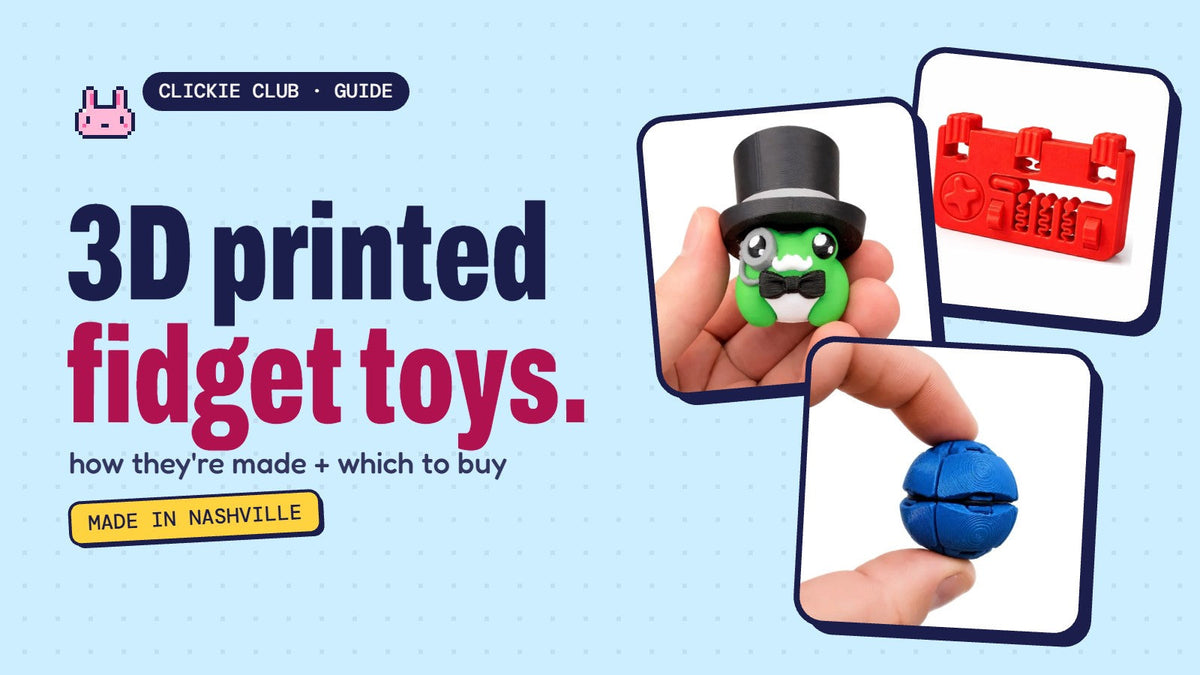
A body with one or more buttons that click. The classic. Good ones have a crisp snap and a button that doesn't wobble. Ours come as characters: the Gentleman Frog (top hat, monocle, one very loud click), the Mushroom, the Strawberry, the Fried Egg and the Daisy. Best for: under-the-desk fidgeting, meetings, anyone who likes a sound.
multi-fidgets
Several motions in one body: buttons, a slider, a spinner. The Multi Fidget Clicker is the one we hand to people who say "I don't know which I'd like." Best for: variety, long calls, kids who switch fidgets every 30 seconds.
fidget balls
A ball made of linked segments that folds through itself over and over. Printed in one piece with every hinge already moving. Zorbles are ours. Best for: quiet fidgeting, classrooms, anyone who hates clicking noises. (We wrote a whole guide to 3D printed fidget balls.)
keychain clickers
A clicker small enough to live on keys or a zipper. The Yeti is a little articulated guy with a click built in, and the custom name clicker is a clicker shaped like your name with a real mechanical keyboard switch inside. Best for: gifts, stocking stuffers, always-with-you fidgeting. More in our fidget keychain guide.
spinners, squishies and the rest
Spinners, gear toys, articulated animals, infinity cubes. Fun, but the articulated-animal category in particular is flooded with cheap prints at the wrong clearances that fall apart. If you buy one, buy from someone who designed it.
how to tell a good 3D printed fidget from a bad one
- Layer lines you can see but not feel. 0.2 mm or finer. Visible stair-steps on a curved surface mean a rushed print.
- No stringing or blobs. Wispy hairs between parts mean bad temperature tuning. They also mean the moving parts may be partially fused.
- A crisp click, not a crunch. A crunch is a layer cracking. It will only get worse.
- Original designs. A lot of marketplace sellers print other people's free files, sometimes against the license. Makers who design their own tune the clearances for their own printer, and the difference shows in the feel.
- Photos of the real print. Renders are not products.
are 3D printed fidget toys safe for kids?
PLA and PETG are the same plastics used in food containers and water bottles, and the printed parts are smooth once broken in. Two rules: not for kids under 3 (small parts, like any fidget), and keep them out of a hot car, where PLA can warp. Our clickers have no loose pieces to come off.
FAQ: 3D printed fidget toys
Why do 3D printed fidgets click so well?
The button and the spring are one continuous piece of plastic, tuned to flex and snap back. There's no separate spring to go soft.
How long does a 3D printed fidget toy last?
Years of daily clicking, in our experience. The failure mode is heat (hot car) or a drop onto concrete at a bad angle. If ours arrives broken or misprinted, we reprint it free.
Can I wash it?
Yes, warm (not hot) water and dish soap. No dishwasher.
Can I get a custom one?
Yes. Names on keychains are a product; anything else goes through custom orders. We're in Nashville and also do local 3D printing.
Do you sell the files?
Some, on MakerWorld, with a commercial license available. See 3D print files.
ready to click?
Everything above is designed and printed by us, one at a time. Start with the fidget aisle, or if you want the whole experience, the Gentleman Frog is the one people buy twice. Free US shipping over $20.
20-second picker
which fidget is yours?
stuff that helps.


more guides.

12 gifts for Pokémon card collectors under $25 (that aren't more cards)
Sleeves, toploaders, a desk organizer, an ornament for their best pull: 12 gifts card collectors actually use, sorted by budget, plus what...
read it →
3D printed fidget keychains: the fidget you can't forget
How fidget keychains are printed, PLA vs PETG for keys, clicker and name keychains, and what to check so it survives a...
read it →
3D printed fidget balls, explained: printed in one piece, fold forever
What a fidget ball is, how the hinges get printed already moving, fidget ball vs infinity cube vs clicker, and how to...
read it →


