
How to Open Pokémon Packs Without Damaging the Cards
The clean way to rip packs: open along the seam, slide don’t squeeze, fan by the edges, and get the hit into a penny sleeve and toploader before the group chat finds out.
in this guide
Nothing in this hobby hurts like pulling the chase card and then spotting a dinged corner on it. Not a scratch from the mail. Not from a trade. From you, thirty seconds ago, in the excitement.
Almost every pack-fresh ding happens in the first minute: tearing the wrapper, fanning the stack, dropping the hit on a crumb-covered desk. Here's how to open Pokémon packs (or any trading card packs) the clean way, in the order that actually protects the cards.
the short version: clean hands, open along the seam, slide the stack out, walk through it by the edges, and the second you see a hit: stop, penny sleeve, toploader. Everything else is details.
what to have ready before you open anything
- A clean, flat surface. No crumbs, no drink rings, no cat. A playmat or a wiped-down desk is perfect.
- Penny sleeves. The soft, thin ones. These go on first, every time, no exceptions.
- Toploaders. The rigid holders. A sleeved card goes into one of these. (Out? Here's where to buy toploaders.)
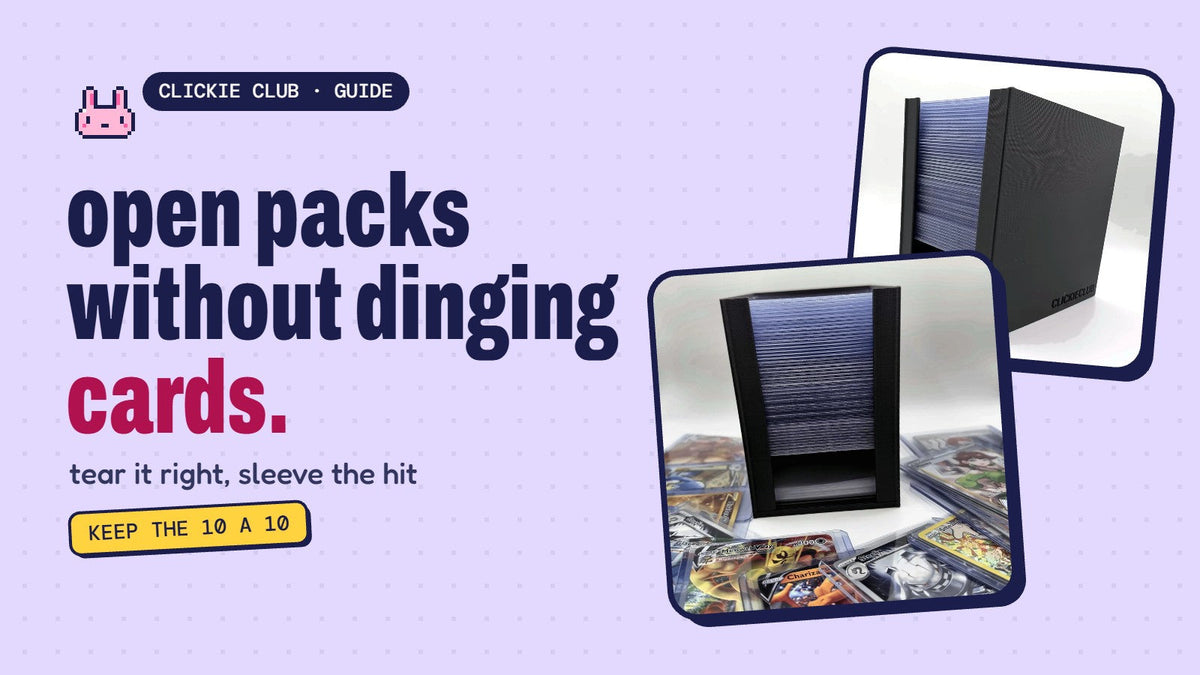
- Somewhere to put the pulls. Reaching across the desk for a sleeve while holding a card is how corners bend. A Ripper keeps sleeves and toploaders standing next to you so you can grab one with one hand; a small box works too.
- Dry, clean hands. Wash them. Skip the lotion. Fingerprints on holo foil are forever.
step 1: open the wrapper from the back, along the seam
Flip the pack so the artwork faces down. Pinch the sealed seam at the top edge and pull it apart slowly along the crimp. Opening along the seam instead of tearing through the middle keeps the foil edge from catching the top card.
No knives, no scissors, no keys. The blade finds the top card before you do. Every time.
step 2: slide the cards out, don't squeeze them
Hold the open pack upright and tilt it so the stack slides into your other palm. Don't squeeze the wrapper to push them out: that pressure bows the whole stack and leaves a crease line across every single card. If they stick, widen the opening a little. Never force it.
step 3: fan from the edges, not the surface
Hold the stack by the edges and walk through it one card at a time, moving each one from the front to the back. Thumbs off the printed face as much as possible. Fanning them like a poker hand drags card surfaces against each other, and that's exactly where holo scratches come from.
Yes, this is slower. Yes, it's worth it. The group chat can wait eight more seconds.
step 4: sleeve the hit immediately
The moment you see a rare, a full art, an illustration rare, or anything you'd keep: stop. Put the rest of the stack down. Pick up a penny sleeve, hold the card by its edges, and slide it in with the opening at the top. Tap gently so the card seats at the bottom.
Now fold the empty top flap of the sleeve down over the back of the card. This little "penny sleeve fold" is why the next step doesn't scratch anything.
step 5: into the toploader, sleeve opening first
Slide the sleeved card into the toploader with the folded end of the sleeve going in first. Put it in opening-up and the sharp lip of the toploader can catch the bare top edge of the card. Opening-first means plastic meets plastic, never plastic meets cardboard.
Done right, you never touched the surface of the card with a fingertip. Feels good, right?
step 6: bulk goes in a box, not a pile
Commons and uncommons still deserve a storage box or a binder. Loose piles slide into each other and pick up edge wear, and a card box costs less than one damaged reverse holo. If your "system" is currently a rubber band, read how to organize toploaders and penny sleeves next.
common mistakes that damage pack-fresh cards
- Tearing the wrapper across the middle. The foil edge scrapes the top card.
- "Searching" a pack by bending it to feel for a thick card. Bends every card in the pack, and the shop owner is watching.
- Opening over a hard floor or a glass table. Dropped cards land on corners.
- Sleeve, then nothing. A penny sleeve alone doesn't stop bends. Pair it with a toploader for anything you care about.
- Lotion, snacks, drinks. Holo foil shows every print and smudge.
- Leaving hits in a stack "for later." Later is when they get knocked off the desk.
does this matter if I'm going to grade the card?
More than anything else. Graders look at corners, edges, surface and centering. You can't fix centering, but the other three are mostly decided in the first minute after the pack opens. A pack-fresh card handled this way has the best possible shot at a 10.
the quick version
- Clean hands, clean desk, sleeves and toploaders within reach.
- Open from the back, along the seam. No blades.
- Slide the stack out, don't squeeze.
- Walk through by the edges, one card at a time.
- Hit? Stop. Penny sleeve, fold the flap, into a toploader opening-first.
- Bulk into a box.
Clickie Club is a small 3D-print shop in Nashville. We make the Ripper, a desk organizer that keeps your sleeves and toploaders standing up and ready while you rip, so step 4 takes two seconds instead of twenty.
stuff that helps.


more guides.

12 gifts for Pokémon card collectors under $25 (that aren't more cards)
Sleeves, toploaders, a desk organizer, an ornament for their best pull: 12 gifts card collectors actually use, sorted by budget, plus what...
read it →
3D printed fidget keychains: the fidget you can't forget
How fidget keychains are printed, PLA vs PETG for keys, clicker and name keychains, and what to check so it survives a...
read it →
3D printed fidget balls, explained: printed in one piece, fold forever
What a fidget ball is, how the hinges get printed already moving, fidget ball vs infinity cube vs clicker, and how to...
read it →


