
fidget clickers, explained: why they're so satisfying + how to pick yours
Why a good click feels so good, how 3D printed clickers are made, the main types, how to pick one in 10 seconds, and how to keep yours clicking.
in this guide
You know the feeling. Someone hands you a little printed frog, you press its hat, it goes click, and twenty minutes later you're still pressing it. That's a fidget clicker. Tiny, pocket-sized, one job: make a satisfying click every single time.
They've taken over desks, keychains and TikTok for a reason. This is everything worth knowing before you grab one: why they feel so good, what they're made of, which kind fits how you fidget, and how to keep yours clicking.
why clickers are so addictive
A good click is a tiny reward. Your thumb pushes, feels a little resistance, then snap: a clear break point, a crisp sound, and the button pops right back. Your brain files that under "do it again." It's the same loop as popping bubble wrap or clicking a pen, except nobody in the meeting wants to throw your pen out the window.
Three things decide whether a clicker is great or just a keychain:
- the snap. Mushy = sad. Too stiff = sore thumb. The good ones have a clean, confident break.
- the sound. Satisfying but quiet enough for class or a call. Solid prints sound deeper; hollow ones sound cheap.
- the shape. If you have to look at it to use it, it isn't a fidget toy. Rounded edges, thumb-sized button, done.
how a 3D printed clicker is made
Every clicker we sell starts as a drawing on a screen. We model the character, then build the mechanism right into it: a thin flexing arm, a snap-fit button, a slider that can't fall out. The printer lays it down layer by layer in plastic filament, usually in one piece, no assembly. A small clicker takes 20–60 minutes.
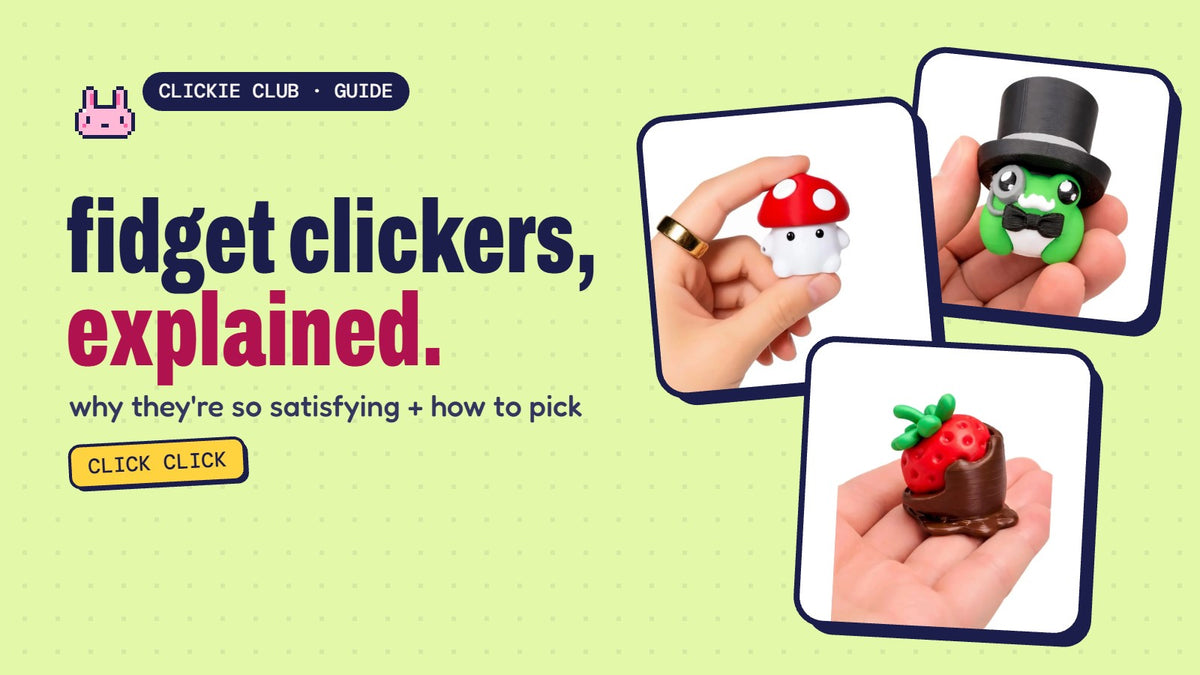
The multi-color ones (a red mushroom with white spots, a frog with a black top hat) come off the printer already in color. The printer swaps filaments mid-print, so there's no paint to chip and nothing glued on.
That's why a small shop can offer dozens of characters: a new clicker is a new file, not a factory mould.
what they're made of (and why it matters)
Printed fidgets are almost always one of two plastics. You don't need to be a materials nerd, but it changes how a clicker feels:
- PLA is stiff and crisp, with the brightest colors. The best-sounding click. Perfect for desk clickers and anything that mostly lives indoors. Just don't leave it in a hot car; it can soften above about 140 °F.
- PETG is a bit tougher and flexier. The click is softer, but it shrugs off drops and pocket life. Better for keychains and anything a kid is going to hurl across a room.
Both are everyday 3D printing plastics. If a listing doesn't say which, ask. And if it's for a little one, check for small detachable parts.
the main types
- single button. One big button, one perfect click. The purest version and the best first clicker.
- multi-fidgets. A clicker plus a slider, a spinner or a switch on one body. For people who get bored of one motion.
- keychain clickers. Smaller, with a ring. Go tougher material, avoid thin bits that stick out.
- twisty and articulated fidgets. Not clickers exactly, but printed toys with linked segments that bend, roll and rattle. The quiet option.
- character clickers. Mushrooms, frogs, fried eggs, yetis. Same click, more personality. These are the ones that get gifted and filmed.
pick yours in 10 seconds
- you click pens: single button.
- you bounce your knee and flip your phone case: a multi-fidget with a slider.
- you need silent: a twisty or articulated fidget.
- it's a gift: a character clicker. The reaction is the point.
- it lives on your keys: keychain size, PETG if you can get it.
keep it clicking
- Wipe it with a damp cloth or an alcohol wipe. That handles 95% of desk grime.
- Pocket fuzz in the hinge? Soft toothbrush or a puff of air.
- No dishwasher, no hot car. PLA will warp.
- If a click ever feels gritty, the tiniest dab of dry PTFE or silicone spray on the hinge brings it back. Skip oils; they collect dust.
do fidget toys actually help?
A lot of people find that keeping their hands busy makes long calls, study sessions and stressful moments easier, and a clicker is a quieter, cheaper thing to reach for than a phone. The research on fidget toys is mixed and they're not a treatment for anything. But if you're going to fidget anyway, it might as well feel good.
quick questions
how much should a clicker cost?
Most printed clickers are $4–$8. Multi-color or personalized ones a little more. Under $2 is usually a mass-produced moulded toy, not a printed one.
can i print my own?
If you have a printer, yes. Plenty of designers (us included) share files free on MakerWorld. Ours are on the free 3D files page.
why does mine feel different from my friend's?
Print settings. Wall thickness, infill and the exact filament all change the snap. That's why clickers from one maker feel consistent and random listings don't.
where do yours come from?
Every clicker in the fidget aisle is designed and printed by us in Nashville, and if one ever breaks we reprint it. Spend anything on the site and you also earn a token for the Clickie capsule machine, which is a whole other kind of satisfying click.
20-second picker
which fidget is yours?
stuff that helps.


more guides.

12 gifts for Pokémon card collectors under $25 (that aren't more cards)
Sleeves, toploaders, a desk organizer, an ornament for their best pull: 12 gifts card collectors actually use, sorted by budget, plus what...
read it →
3D printed fidget keychains: the fidget you can't forget
How fidget keychains are printed, PLA vs PETG for keys, clicker and name keychains, and what to check so it survives a...
read it →
3D printed fidget balls, explained: printed in one piece, fold forever
What a fidget ball is, how the hinges get printed already moving, fidget ball vs infinity cube vs clicker, and how to...
read it →


